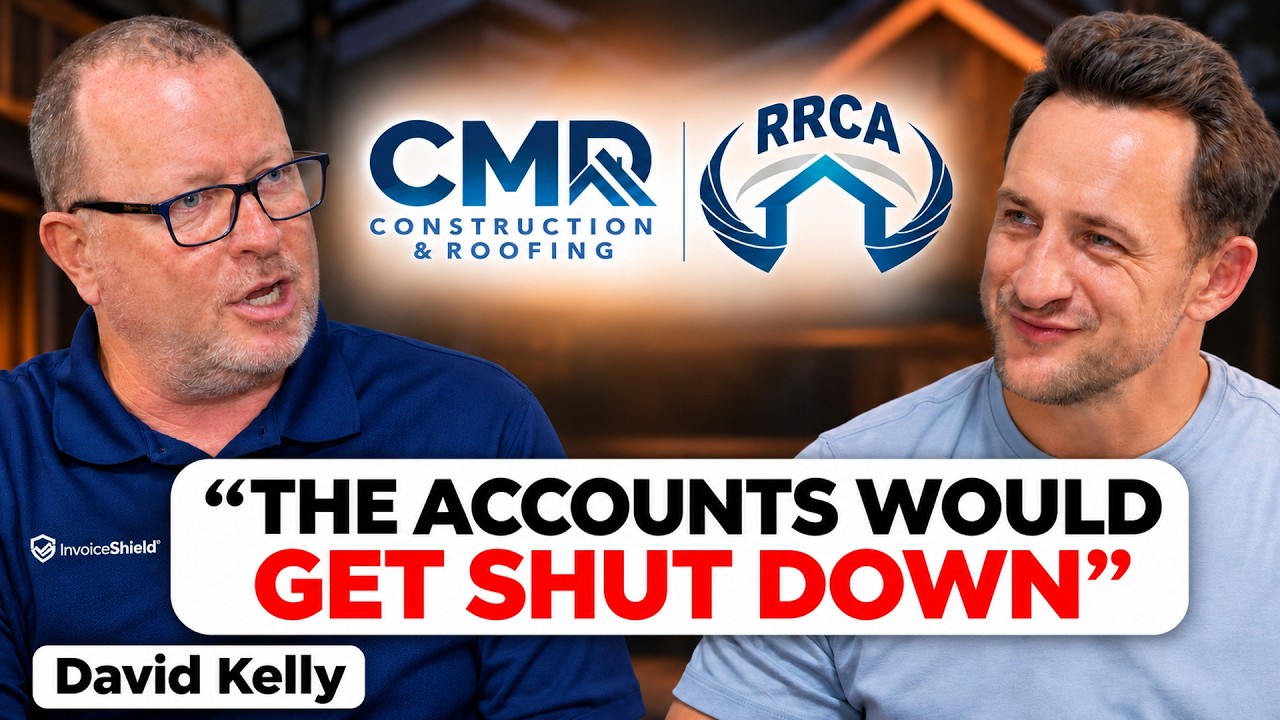





In a 76-minute interview, former RRCA and CMR executive David Kelley walked through why large Florida roofing companies have gone under, and why the old line that "sales cures all woes" does not hold up once the jobs are in the hopper.
Kelley ran the office at RRCA, Lee Haight's company, after Hurricane Irma, then later took a leadership role at CMR. He is careful about both companies' current finances. What he will say is that the same problem showed up in both places: cost control.
Watch the interview below, or skip to 10:12 on why big Florida roofing companies went under, 16:29 on the most expensive financial mistake Kelley says contractors make, and 01:02:33 on why sales alone will not save a company.
A SET, a storm, and why "away money" costs more
Kelley came up through storm restoration. At 05:38, he defines a SET the way operators actually use the term: you partner with a local company after a weather event, bring in money, salespeople, and processes, and sell under that company's name.
Those partnerships often fail, he says at 06:51, when the money, the leads, and the decision-making are not clear from day one. In 08:01, he goes further: he does not see a need for storm chasing in 2026. Local work, in his phrasing, is simply worth more.
"Home money is worth twice as much as away money."
That is the backdrop for the rest of the conversation. The companies that got huge on storms still had to pay suppliers, pay crews, and keep a reserve. Volume did not automatically do that work.
What Kelley says he saw at RRCA
Dmitry asked why so many big Florida players ended up upside down. Kelley started with RRCA, and he named Lee Haight as the owner, not as the company itself.
After Irma, Kelley says he was managing the office and doing large numbers, in the range of $20 to $30 million a year. He credits tight cost control for the way the office ran at that time. Haight, he says, was very focused on Sky Diamonds, which left Kelley to run day-to-day operations.
According to Kelley, the office had zero debt to the supplier, the salesmen were paid, capouts were transparent, and there was a reserve in the bank. He also put this on the record more than once: Haight always came up with payment in full, including distributions. After a later change in management, Kelley left. He says he was off the job for about six months, and that Haight still maintained his pay, including distributions, during that period. He later picked back up with the company for a storm in Lake Charles, Louisiana, but he was no longer involved in general management.
Asked about RRCA's position now, including cash issues, Kelley would not claim a precise diagnosis. "It's hard for me to tell you exactly."
Then CMR, and a Florida role he did not originally want
After the New Orleans storm work wore him out, Kelley was living in Mandeville, Louisiana, and not looking for a big management job. He reached out to Steve at CMR and asked if there was a position. He says he would have taken a runner job.
Steve invited him in, gave him a role in Louisiana, and later a title Kelley remembers as something like national director of sales and storm sales. The company, at that point, "had a lot of health." Kelley was doing specialty work, including slate and copper, and sitting on leadership calls.
On those calls, he says, the person who had built CMR's Florida sales force, "many, many hundreds and hundreds of salesmen," was named Danny. Danny and Steve used to have open arguments over money. After Danny left, Steve asked Kelley to step into the Florida role.
That is when the picture changed. At 14:59, Kelley describes accounts getting shut down and having to be rebuilt with suppliers. He stayed almost two years. Around the second year, in the third quarter, he was drafting cuts: liquidate vehicles, reduce staff, shrink the operation. He was on a high six-figure salary, and it became clear, in his telling, that he should go for the health of the company. He worked through a quarter of that wind-down.
Does he think CMR will make it? He does not claim to know their position now. After he left, he says, they still had about 2,000 jobs in the hopper, and "from my understanding is they completed them." What he will stand on is the shared issue:
"I do know where the problem was in both those companies, or in any company. Most of it has to do with cost control."
That lines up with a pattern we have covered before in how a $10 million roofer goes broke: revenue can look healthy while the back office is already failing.
The most expensive mistake: unpaid and late supplier bills
At 16:29, Kelley names the most expensive mistake he has made, and the one he cannot blame on anyone else: not maintaining supplier bills, not paying on time or early, missing the early-pay discount, and letting a balance sit and accrue interest.
"That is definitely the most mistake. That is the primary mistake most companies make."
The numbers he uses as a baseline come from years of jobs, including what he says was about 35 drops a day at CMR, and from RRCA's own CRM, Claim Express. Labor, in his model, should run 32% to 35%. Materials, when he really looks at it, run around 36%. That leaves less room than owners think once commissions, marketing, and overhead come out.
He also warned about 70/30 splits that give the sales rep 70% and the company 30%. "They're going to have a hard time maintaining their position as a healthy company." In his words, it "sounds desperate." The group that is easiest to squeeze, he says, is not actually the salesperson. It is the supplier, because suppliers compete for the work. That is a dangerous place to get sloppy, and it is why the invoice side of this interview matters. We broke that piece out separately in how roofers recover 2 to 3% in supplier invoice overcharges.
"Sales cures all woes" is, in his words, an absolute falsehood
At 01:02:33, Dmitry puts the industry saying to him directly. Kelley does not hedge.
"It's an absolute falsehood."
He uses CMR as the example, and he goes out of his way to vouch for Steve. He says Steve never had an intention of not paying salesmen, not paying the supplier, or not delivering for the homeowner. They had sales. "There was hundreds of salesmen bringing in jobs every day. It did not cure all woes."
Then the line he wants contractors to remember:
"Efficiency cures all woes. Efficiency with what you got. Sales does not cure what you keep."
Easy storm work, in both of their views, also goes out easy. Kelley says there was a point in his career when he knew exactly what it cost when a salesperson handed over a folder with an estimate and a business card: $218. That number still matters, he argues, no matter how successful the company looks.
His practical advice, at 01:07:42, is not complicated, and it is easy to skip when a storm is producing 30 jobs at a time. Know your direct cost. Train salespeople to break a roof down by square foot, linear foot, and parts and pieces. Know labor, variable costs, and fixed costs. Find the lowest price you can tolerate while still covering owner compensation and taxes.
"You have to be able to know how much a roof is going to cost you before you can sell it."
Then verify. Verify materials, labor, whether the salesperson actually documented the work, and whether the crew replaced three pieces of lumber or invoiced for 10. "Treat every job like it's your own, and always do a post [evaluation]."
The homeowner side of the same conversation, including how long a roof should actually last, is in how long should a roof really last, and the 15-year debate.
If you are a contractor, fix cost control before you add more sales
If you are a contractor watching volume cover up weak cost control, this interview is a warning, not a growth pep talk. Get the back office right before the next storm makes the numbers look better than they are.
If you want structured help on accounting, sales, marketing, and operations, start with Roofing School. You can also schedule a call or apply to list your company on Directorii.