

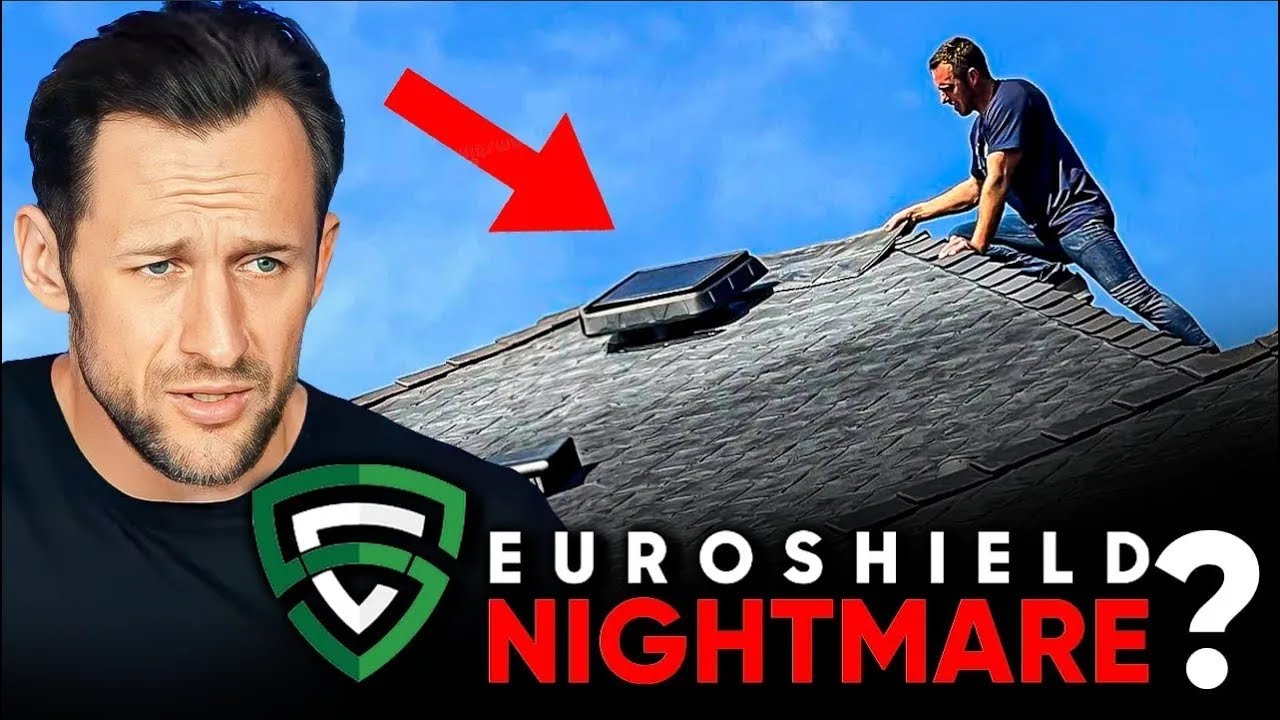


In 2023, a post about Euroshield rubber shingles went viral, and the pictures did not look very good. I talked to Lesley Gustafson, the president of Euroshield, to understand what took place, and I want to walk you through what I found.
This is not a recap of every rubber shingle on the market. I have already covered Class 4 rubber shingles and real slate versus synthetic slate. This article is about one dispute, how Euroshield handled it, and why I still recommended the product after I investigated it.
Euroshield is a Roofing Insights partner. You can read more on our Euroshield partner page. That does not change the questions I asked, or the conclusion I reached on camera.
The viral post that started this
Someone named Sean McCord posted what he called an unpopular opinion. He said this was his first and last Euroshield rubber roof, and he framed it as a heads-up to any contractor or homeowner planning on installing the product.
As I read it on camera, he said the Vermont Slate HP shingles faded to a lighter color around a solar-powered fan, which he said was supposed to be impossible according to Euroshield. He went on a rant. He said someone named David was absolutely awesome through the whole process, then warned people not to be fooled, and said the company would try to find a way out of its defects. He posted pictures, and those pictures did not look very good.
So I dug into it.
Why I liked how Euroshield handled the dispute
I want to say this right away: I absolutely loved how Euroshield approached this dispute.
Manufacturers these days have 2 options. Option 1 is to send a cease and desist letter, try to shut the contractor up, and maybe go after the homeowner. They may have legal rights to do that, and that is why so many companies do it. Option 2 is to try to fix the problem, open their ears, and see if there is anything they could do differently.
Euroshield chose the second option. They decided not to fight back and not to send lawyers. Lesley jumped on a plane and met with the homeowner.
Here is the part a lot of people missed. The homeowner did not have a problem with the product. The homeowner was happy with the roof he chose. The problem was a little different, and I wanted you to hear it from Lesley, not from me repeating a screenshot.
What Lesley said after she met the homeowner
I talked to Lesley the morning after she met the homeowner. She was in Mobile, Alabama, waiting to head back to Calgary. She said they had discussed everything and had pretty much settled the case.
The resolution, she said, was to leave the roof as it was. The homeowner was comfortable with that.
She described a large house, about 6,000 square feet, with a very large attic of about 3,000 square feet, high ceilings, and a power vent. It was well ventilated. When she was there, ambient air was around 85 to 88 degrees. The air in the attic was around 110 degrees, and she said the underside of the roof deck was around 119 degrees fairly consistently.
Away from the vent, she said the shingle surface temperature was about 153 degrees. Right around the vent, because of the high volume of air flowing, it was right around 117 degrees. That is a significant temperature difference. The fan is a solar fan, and she said it is also hardwired, so it is always running.
Her explanation was the reverse of what a lot of commenters assumed. People thought hot attic air was blowing out and aging the shingles around the fan faster, making them lighter. Lesley said the airflow was keeping the material around the vent from weathering in as fast as the rest of the roof.
She also said Euroshield's base material is recycled tires, so the base is black. As the color pigments break down, she said their material gets darker, not lighter like a plastic-based product such as vinyl siding. In her account, that color change happens fairly rapidly, in about the first year. On this roof, the shingles that were not right around the vent had weathered in and darkened. The shingles right near the vent had not fully weathered in yet.
She said they do not typically see a vent create that much difference in how a roof weathers in. This was a very large roof, a large attic, and a solar fan that was working well. All of that came together.
If the homeowner had wanted a visual fix, she said he could turn the fan off and let that area weather in, or ventilate the attic a different way for a while. There was even a faux window where the glazing could be removed. His preference was to leave it as it was. She said he is proud of the roof, and neighbors come by to ask what is on it.
Those temperatures, attic sizes, and the "leave it as it is" resolution are Lesley's account of the visit. I was not on that roof with a thermometer.
My take: this was not a product defect
I think Lesley described it pretty well. I want to add that this is a business problem. We fix problems on a daily basis. Every job is different. Stuff will break in a way it never broke before. What matters is how you solve it.
In that video I said it proudly: I still recommend Euroshield. The next day I had an insurance adjuster coming to my house to look at my roof. I was also replacing windows, and I was working with a contractor I recommend. I had not even checked the roof myself for wind or hail damage. I let someone else do that. And I said if I did need to replace my roof, I probably would go with Euroshield. It was still on top of my list, despite posts like this, and despite how fast some contractors like to react.
This is not a typical situation. I used a simple example on camera. If you get a carpet wet and put a fan on one area to dry it, that area is going to dry faster and change color faster. That is basic physics.
In my opinion, it is not a product defect. It is not fair engineering toward that product when you have that kind of airflow on only one part of the roof. The color will be different. Many products would have a problem in this condition. I do not know what a metal roof would do. Would it expand? Would the finish change faster than the rest of the roof? There are many factors.
Yes, the fan did discolor the area at the peak. Yes, in certain lighting, at a certain time of day, it might not look very good. The homeowner was still proud that he had Euroshield on his house. If that kind of look would be an eyesore to you, then maybe do not do it, and maybe research the fans next time.
The lesson for the next roof
At the very least, we learned another construction lesson. Before you even touch a roof replacement, look at what kind of fan is ventilating that roof, what size it is, and what kind of temperatures you are dealing with. That is one more factor that can affect discoloration later.
I said it could probably happen to other products too, including DaVinci and F-Wave. Then I stopped myself. I do not want to speculate. We do not know what we do not know.
Euroshield acted really well, exactly the way I expect manufacturers to act. I thanked them for that. As a manufacturer, you are going to have claims. Every company has them. Toyota and Mercedes have recalls. Phone makers produce bad phones. We still like those brands when they fix the problem. It is how you fix it that matters.
If you believe in a product, you are not going to turn away because you heard one story. You are going to investigate. I investigated this one. I did not have any reason to turn away from Euroshield. As a content creator, I said I would still support them, and I still want to tell stories of homeowners who picked the product.
I know it was stressful for their team when the community was bashing them. I think the way they acted was honorable, and I still support them. If you want current product details in their words, go to Euroshield's site.
FAQ
Do Euroshield shingles discolor?
In this case, the area around a solar-powered fan looked lighter than the rest of the roof. Lesley said the rest of the roof had weathered in and darkened, which she says recycled-tire rubber does as pigments break down, while the shingles around the constantly running fan had not fully weathered in yet. I agreed the fan did discolor the area at the peak, especially in certain lighting.
Is Euroshield discoloration a product defect?
In my opinion, no. I said it is not a product defect, and it is not fair engineering toward the product when that much airflow hits only one part of the roof. I compared it to drying a wet carpet with a fan in one spot.
Did the homeowner want the roof replaced?
Lesley said the homeowner was happy with the roof, proud of it, and comfortable leaving it as it was. That is what she told me the morning after she met with him in Alabama.
Do I still recommend Euroshield after this?
Yes. I said that proudly in the video. I had investigated the claim, I liked how they handled the dispute, and Euroshield was still on top of my list if I needed to replace my own roof.
Could this happen with other roofing products?
I said many products would have a problem in this condition, and I mentioned DaVinci and F-Wave as products that probably could be affected. I also said I do not want to speculate beyond that.
Related Roofing Insights articles
For more of my Euroshield coverage, see the partner page, what a hail tester told me about smell and hail, and the Rapid City hail case studies. I also have a broader look at Class 4 rubber shingles and a real slate versus synthetic slate comparison.
Find qualified roofers near you on Directorii, backed by a $30,000 guarantee.